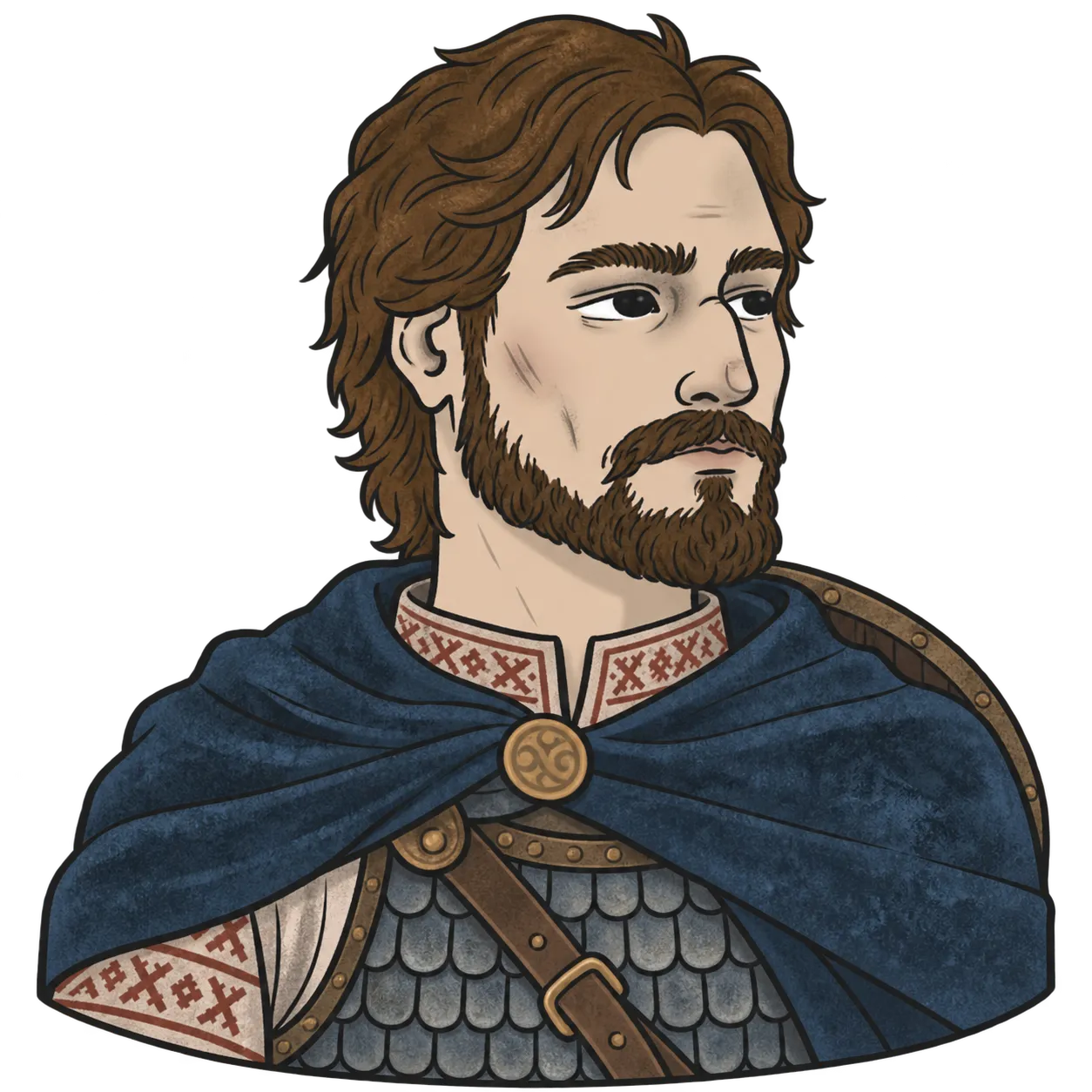
Velemyr
Heavily armed thrower, support fighter
- Age
- 29 years
- Origin
- Voin on the Sula, a border fortress beyond Pereiaslav
- Station
- A free man, a farmer's son
At a glance
A powerful javelin thrower built around hard, accurate throws. A deep stamina reserve lets him keep up the pace for a long time, and heavy armour lets him keep his position through a stray hit. A small pool of health makes a drawn-out exchange dangerous; the axe is a last resort.
History
Velemyr was once ordered to fall back, and he fell back. The order was right. He still thinks so.
That is the whole difficulty of his story: there is nobody to blame.
The family outside Voin was large and had just enough land to get through a bad year without going hungry: a few horses, a smallholding, and not a mouth to spare. Velemyr was the eldest of three sons and was used from childhood to the fact that nobody would do the heavy work for him.
His father was no soldier, but like most men of the borderland he had a spear, an axe and a shield. When word came of a raid or of danger on the road, the men of the nearby settlements gathered, set a watch, and saw carts through to safer places. Velemyr went out with such a party for the first time at sixteen.
No real fighting happened then. They froze on a watchtower above the Sula for three days, twice saw strange riders in the distance, and went home. Even so, that life made sense to him: wait, watch, spend no strength without need, and be ready to act when it is genuinely required.
He began going out with the watch parties more often — escorting merchants, guarding cattle on the drives, and several times joining the pursuit of small bands of robbers. He took up the javelin in those years. For a man who had no expensive bow and no time for constant practice at shooting, it was a plain and comprehensible weapon. Velemyr did not try to throw as far as possible: he waited until an opponent came close enough and made one hard, accurate throw before the fight came to close combat.
It turned out quickly that this weapon suited him exactly. Years of work on the holding had given Velemyr strong shoulders and endurance. He could put his whole body into throw after throw without tiring as fast as most men. In time he learned not merely to throw hard but to throw with the same confidence even after a long fight.
At twenty-three Velemyr married and for several years almost stopped going on distant campaigns. He worked with his father, built a homestead of his own, and gradually passed the watch duty to his younger brothers. It seemed to him that there had been enough soldiering in his life already.
Then came the winter raid. The watch saw the attackers too late. Some of the inhabitants got behind the defences in time, but several homesteads were left outside. Velemyr was among the men ordered back to the gate and told not to try to defend individual houses.
He carried out the order. When the raiders had been driven off, his own homestead was burned and his wife was dead.
He did not come out of that night whole either, though his injury came after the fighting. Velemyr threw himself into clearing what was left of the homestead too hastily and several hours too late; a burned beam came away from the wall and caught him across the chest. The ribs healed crookedly and still ache when the weather changes. His shoulders and arms stayed exactly what they had been — his throwing was not affected in the slightest. But a heavy blow to the body is one Velemyr takes worse than a man of his build ought to, and nobody knows it better than he does.
Velemyr has never blamed the men who ordered the withdrawal. He understands that the decision was right and that trying to defend a few homesteads could have cost far more lives. Since then, however, he is very reluctant to leave a position that can still be held.
He spent the next several years back in watch parties and hired companies, and he began wearing heavier gear than most men who fight with thrown weapons. At first that was simply the result of those ribs and an unwillingness to rely a second time on the enemy missing. Later it became part of how he fights.
Velemyr sees little value in constantly falling back and looking for a new position. If a place is good it should be held; if the enemy wants you out of it, let him spend his own strength on that. Heavy armour lets him take a stray arrow, a stone or an unlucky blow without having to abandon his whole plan.
But he knows the limits of that protection well. He is not a front-line fighter and not a man who can trade blows for long. The armour is there so that he need not leave good ground over the first hit, not so that he can go looking for hand-to-hand. He carries the axe for the same reasons as most borderland men: it is a working tool, a weapon, and a thing that may always be needed on the road. Velemyr does not consider himself good with an axe. If an enemy has reached him, something has already gone wrong.
In a fight he almost never hurries the first throw. He can wait a long time for an opponent to come out from cover, turn side-on, or come close enough that a miss becomes unlikely. Because of this he is sometimes thought slow. Velemyr himself thinks that a miss from haste is simply a weapon thrown away. But once the fighting has started and targets come one after another into good range, he holds his tempo far longer than seems likely. Where another javelin-man begins to husband his strength, Velemyr goes on working. That is where he sees his advantage: not to make one impossible throw, but to make many hard ones and keep throwing well as fatigue sets in.
He knows more about Melania than she knows about him. They crossed paths twice, and the second time somebody at the fire retold the story of the crossing: how she refused to withdraw and held the attackers while the people of the settlement fled. Velemyr listened without a word. Then he got up and went to check the horses. He does not think she acted rightly. He also has no right whatever to think so, and he understands that perfectly. He has not spoken to her once since that evening.
With Hlib, Velemyr served a whole summer. What had happened to each of them neither man ever raised, though both worked it out quickly enough. Only the silence was a different silence. Beside a man who also carried out an order and also cannot call it the wrong one, Velemyr finds silence easy — which is exactly why there was nothing to say.
With Predslava it is simpler, because there the argument is only about iron. Both of them hold a position to the last; the difference is that Velemyr takes armour and Predslava refuses it on principle, and each considers the other reckless. He once asked her outright what she would do when the shield was too slow to stop a blow. Predslava answered that in that case the shield had not been where it should have been. The answer did not reassure him.
In camp he almost always finds himself work. He knows horses well, can mend simple harness, get a wheel back on an axle, sharpen an axe, or help fortify a camp. He dislikes sitting idle and has little patience for people who complain of being tired before the work is finished. He speaks little and usually only when he has something to say. He takes quarrels calmly, but once he has taken a position he is hard to talk out of it.
He does not like complicated plans with many conditions, and particularly distrusts the ones in which somebody has to arrive in time, fail to notice something, or be certain to fall back. Velemyr always asks what to do if that does not happen.
Last autumn the band withdrew from a hill from which they could cover the road well. Velemyr was the last to be ready, and he was not quick about it: he gathered up the javelins, straightened a strap, looked down once more. Nobody said anything to him. He saw the position better than any of them — and for exactly that reason did not consider the danger sufficient reason to leave it. Sufficient reason, for him, is an order — and an order he once carried out promptly and correctly, and it saved nothing.
If he is told to fall back too early, he obeys. But he almost always looks over his shoulder. Sometimes twice.