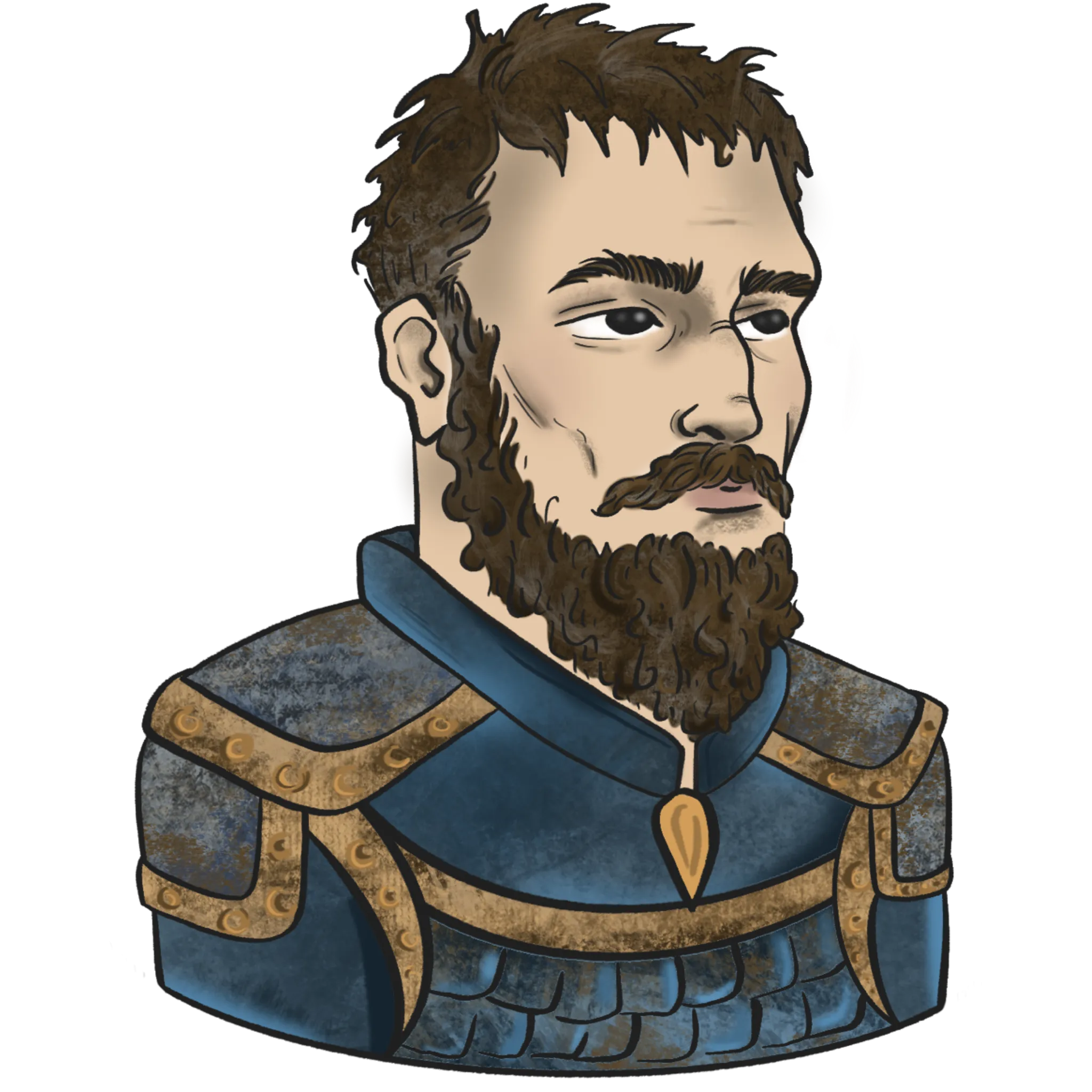
Leader
Ratybor
Shieldman, seasoned fighter and the warband's de facto elder
- Age
- 44 years
- Origin
- Hnidyn, a village on the left bank below Kyiv
- Station
- A senior retainer of common birth
At a glance
An experienced shieldman who holds the front line and absorbs enemy pressure. He is not always the one to finish a fight quickly, but he gives the rest of the warband time to take the positions they need. Strongest where the task is to hold out, not to cut the enemy down fastest.
Through the leader's eyes
Ratybor thinks of those who will still use the road after the warband moves on. Defeating one band will not protect the next caravan if no one is left to hold the crossing. He wants to restore an order in which paying for protection means being protected. He knows his part of the work. The question is who else will agree to do theirs.
History
Ratybor owns a thing he almost never uses. The great war hammer has hung at his saddle for a dozen years, and in that time he has taken it down perhaps twenty times. He remembers every one of them.
Because taking up the hammer means putting down the shield, and putting down the shield means holding the enemy is no longer enough.
The forge at Hnidyn was his father's, and that is where Ratybor learned to use his hands. A smith he never became: in his youth he was big, strong and quick-tempered, and after one more quarrel he left home, joined the town levy, and from there came into the prince's retinue. He had no relations of influence, so everything he has, he earned in service. At first he minded horses and gear, patched mail, straightened dented shields, kept count of stores. The levy's shields in those years were mostly Bilhorod work: badly painted, but with the fittings set so well that after a hard blow it was the wood that split and not the strapping. Ratybor became a fighting man later than his age-mates did.
He was never the fastest or the most elegant fighter. He was valued for something else: Ratybor held his ground when the men beside him began to give way. He held the line. He covered the wounded. He kept his head when a battle turned into a press where nobody can hear anyone.
In time they began putting him in front of the younger men. That is how the mace and the heavy shield stopped being merely his gear and became his way of fighting. Ratybor does not look for a fine duel and does not try to land the decisive blow first. He absorbs the enemy's push, holds his place, and does not let the enemy through to the people behind him.
His armour is accordingly the heaviest he can afford. Ratybor does not evade — it is simply not his way of fighting. He holds his ground and has to withstand whatever comes at him; every extra layer of iron is a few more blows he can take without moving. He knows exactly what he pays for it: in heavy gear you will not run anybody down and you will not get away from anybody. He intends to do neither.
He values the mace for its honesty. It works in a press, it lets him strike short from behind the shield, and it needs no wide swing. He does not consider it a noble weapon — which is exactly why he trusts it. A mace promises nothing but a heavy blow.
He keeps the hammer for the times when holding the enemy is no longer enough: when a shield has to be broken, armour crushed, or a man stopped who will not be stopped by anything smaller. He handles it well. He does not like it. Without the shield Ratybor feels unprotected less in his body than in his head: with mace and shield his task is plain — hold and cover; with the hammer he has to choose the target himself, take the risk, and strike.
In more than twenty years of service Ratybor has outlived several princes and a great many small campaigns nobody made songs about. His first years were in the prince's retinue under two different voivodes; only later did he join the warband Mstyslav raised. He was married. His wife died in a difficult childbirth and the child did not live either. He did not marry again.
He has almost no contact with his kin. His father is long dead, one brother keeps the forge, the other went into a monastery. Ratybor sometimes sends money to his brother's family but has not visited them in years. He explains this to himself as service. In truth he simply does not know how a man goes back to a life he walked out of at twenty.
Besides fighting he can judge the state of a weapon or a hauberk, mend the simple things, lay out a camp, set a watch rota, and get people out of harm's way without panic. He teaches the young well enough, though he rarely praises them out loud.
He is a man of few words but not a grim one. He has a dry humour and delivers a joke with an entirely serious face. He dislikes boasting and almost never mentions his own victories.
In camp he looks after the others in a way meant not to be noticed: checking straps, driving the young men to dry their clothes, mending someone else's gear, leaving somebody the better portion. Thanked for it, he answers that he simply does not want to carry a weakened man on his back the next day.
Under Mstyslav, who raised this warband, Ratybor served longer than anyone still left in it, and buried him himself in the spring. The banner passed to the son, as it should — and the men, as before, come to Ratybor with their questions.
He did nothing to bring that about and does nothing to change it. He has nothing to set against Liutobor's right: no house behind him, no land, not even a charter from the prince — only twenty-odd years of service and a heavy shield. Nor does he want to challenge it. Ratybor knows one thing about himself far too well: in a fight he decides fast, and outside a fight he does not decide at all.
The hardest of them for him is Liutobor. Ratybor has seen dozens of such lads — able, loud, certain they are underrated — and buried half of them. Liutobor hears in every remark of his something that is not there, and does the opposite out of spite. Ratybor knows he ought to speak to him differently. He cannot. In the retinue he was taught to say “stand” and “hold”, not to explain to a young man that he has nothing to prove to anyone — least of all to Ratybor.
He once served alongside a man named Hlib, who left a boyar's retinue over an order he had carried out. Ratybor did not understand him then and said so aloud: the order was lawful, the retinue had done its work, and what came of it was not Hlib's to decide. It took a few years before Ratybor stopped being sure of that. He still does not know whether he would want to meet that Hlib again.
His worst trait is an inability to let go of responsibility for other people. Ratybor is convinced he must foresee every danger and correct every mistake anyone else makes. If someone near him dies, he always finds his own share of the blame.
And at the same time, in the large decisions, he looks for an order, a law or an elder to lean on. In battle Ratybor acts fast. Out of battle he is afraid to decide by himself what is right, and calls that discipline. Discipline has nothing to do with it. In a retinue the man who gave the order answered for the mistake, and for twenty years Ratybor was the man who carried it out. The elder he leaned on was buried in the spring. The orders are now given by a twenty-three-year-old who leans on him.