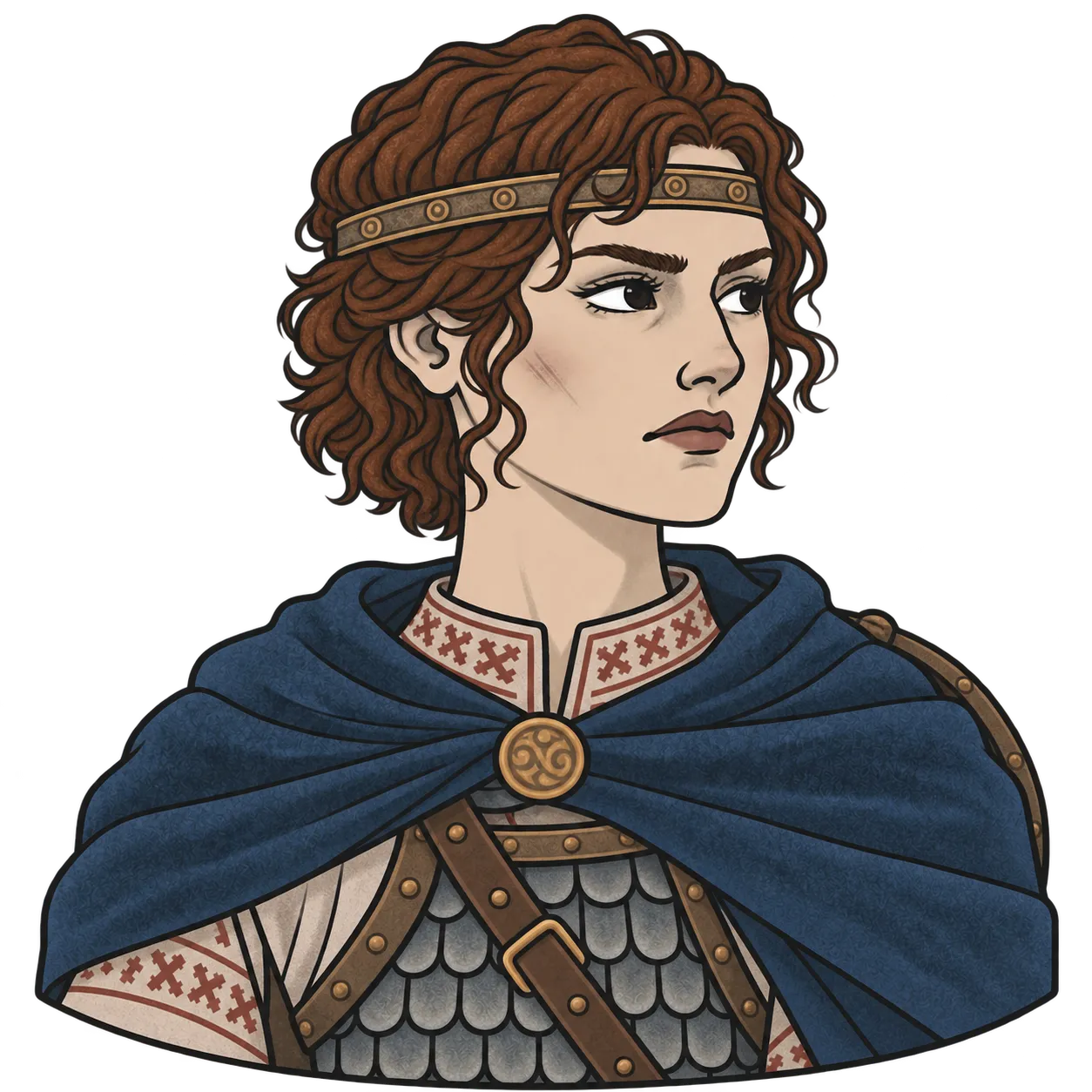
Yanka
Mobile fighter, finishing the wounded and striking exposed targets
- Age
- 24 years
- Origin
- Kyiv, the Podil
- Station
- A free woman of the Podil poor
At a glance
A fast scramasax fighter, dangerous to wounded or exposed enemies. She takes a medium shield for a direct approach, paying for cover in accuracy and effort. Her light armour offers little safety in a prolonged exchange of blows.
History
People hired Yanka because she did not look like a fighter.
At first, many took her for a merchant's younger relative or a servant travelling with the caravan, and understood their mistake only once the fighting had started. That did not make her a stealthy killer: Yanka cannot move up on a man unseen, sees no better in the dark than anyone else, and killing people in their sleep is simply work nobody has ever offered her. Her advantage is far simpler — in an open fight Yanka acts faster than anyone expects of her.
She never had money or status behind her. Her mother sold on the Podil market whatever she had managed to buy cheaper: fish today, thread tomorrow, nothing the day after. Her father worked as a porter on other men's carts and was at home no more often than strangers were. They lived in a corner of somebody else's house above a gully that was undercut every spring. Yanka was the youngest of three children and understood early a simple thing: out on the street, you count for nothing. The yards, the gaps between homesteads, the warehouses by the wharf, the cheap taverns, and the places where you could get from one street to another faster than by the main road she knew better than most grown men.
She learned to count money before she had any of her own, and spotted almost unfailingly when someone was trying to cheat her on change. Haggling she disliked all the same: if a conversation dragged on too long she might accept a worse price simply to have it over with. At the market she was taken on to carry, to hold a place and to run errands, and that is how she came to know half the city.
Her first scramasax came to her second-hand: a cheap blade with a worn-off maker's mark that her elder brother had got from a watchman for half a day's work. For a long time Yanka carried it as a tool: cutting cord, opening bales, gutting fish. She learned to fight with a short blade much later.
At seventeen she began spending time in a tavern on the Podil where carters, hired guards and porters gathered. There she met Dobryn, a former retainer of the prince's who now went out with hired companies and often stopped in Kyiv between campaigns.
Dobryn did not teach her complicated techniques. He repeated one thing: a short weapon does not forgive hesitation. If you have already come that close to a man with a sword, an axe or a spear, there is no time left for fancy moves. You have to act before he does.
Yanka proved very good at it. Strength she had little of, and under heavy gear she felt shut in. Her speed, on the other hand, came naturally: Yanka had a good sense of the moment and hardly hesitated after a failed move. If the first blow did not go through, she did not try to force the same guard: she changed the angle, took another step, looked for another opening. And sometimes simply for another target.
Dobryn spent a long time trying to explain to her that speed is only useful as long as a person is the one deciding where they are going. Yanka remembered the phrase. Putting it into practice was another matter.
Later she began earning by escorting small loads within Kyiv, and then short caravans between neighbouring towns. During one raid Yanka first understood the weakness of that style too. One of the attackers had already been wounded by another guard; she saw the opening, went forward and finished him quickly, wounded the next man first, and did not see the third. The blow caught her in the side and broke two ribs. Had another guard not stepped in, Yanka would most likely have died in her first serious fight.
That should have made her more careful. It did. Just not as much as the people around her would like. Yanka took light armour: after the broken ribs, going out without any protection seemed foolish. She tried heavy armour too, but refused to pay for it with every step. She needs protection that still lets her change her mind and go another way.
She argued against a shield for longer. Eventually she took a medium one for the times she has to approach an enemy straight into his weapon. The scramasax stays the same, but behind the shield it is harder to land a blow, and each strike takes more effort. When she can come in from the side, Yanka prefers to keep her hand free. She has admitted that a shield is useful; she still argues every time about whether she needs one.
Some years later Yanka met Dobryn again — by then with a crippled leg. Of what had happened he said little: the leg was broken in a skirmish, the band went on without him, and he was left in a strange village with a purse of money and an arrangement with a local family. Who exactly made that decision Dobryn never named, and Yanka never asked: from the way he did not speak about it, it was clear it had not been an enemy.
Yanka understands perfectly that she will not survive what a heavily armed fighter survives. She does not hold passages, does not stand in front of several enemies, and does not like a long exchange with a man ready to answer every one of her thrusts. Even with a shield she keeps looking for somewhere to move so that the next blow passes her by.
Which is why she is always looking for the moment when an opponent is already busy with somebody else. What she likes best is an enemy who is not looking at her. If a comrade has an opponent locked in a fight, if he has turned side-on, if a wounded man is trying to withdraw, if a ranged fighter has been left without cover — that is when Yanka considers it her turn.
She is especially dangerous against the already weakened, and not because a wounded man is easier to kill. Something else matters more to her: a wounded man has already made part of his decision. He is falling back. He is covering the wound. He is watching whoever wounded him. Which means he has less attention left for Yanka, and often that is all Yanka needs. One enemy who is no longer a threat is almost always worth more than two slightly wounded ones. Because of this her decisions sometimes look cruel. Yanka does not think so: if a man has already entered the fight, leaving him alone merely because he is wounded is a strange notion of mercy.
After some years escorting caravans she joined a small group of mercenaries and for the first time began fighting not as a guard hoping to avoid a scrap but as a fighter proper. The company was a good one, and short-lived. Its leader liked risky contracts because they paid more, and that suited Yanka entirely as long as everyone shared the risk.
Then the company was to take a merchant through country where a large band of Tati was operating. The leader knew the danger but hid it from most of his people, having arranged double pay for himself and his two closest men. The caravan was attacked. Several people died. Yanka survived and learned the truth only after they got back.
She did not plot revenge and did not try to kill her former leader. She simply took the money owed to her. Then she took a further part of his money on top. When he tried to stop her, Yanka said he could either accept that sum or explain to the other mercenaries exactly how much he had been paid for their lives. He accepted.
Since then she reacts very badly to people who hide a risk from those who have to carry it. Danger she knows about frightens her little. What she cannot bear is something else: somebody deciding on her behalf that she does not need to know.
She and Dzvenyslava have already quarrelled over this in earnest. Some years ago they ran a caravan together, and Dzvenyslava held back word that the road ahead was being watched — she judged that knowing would help nobody. Yanka found out in the middle of the fight. Dzvenyslava is convinced to this day that she did right. Yanka finds it far easier to forgive a bad decision than a decision made for her.
With Hlib it is the other way round: he has irritated her since the first hour and she has liked him for years. He moves later than she needs, attacks targets she does not consider the important ones, and will not leave good ground for the chance to finish quickly with a wounded man. Yanka calls him a man who will first ask his own shield for permission. And yet it is beside Hlib that she finds it easiest to fight, because he gives her what she lacks herself: a fixed point to take risks around.
Away from battle Yanka is loud, curious and makes acquaintances extremely easily. She can sit down beside a stranger, know within ten minutes where he is travelling from, and within an hour be arguing with him as though they had known each other for years. She cannot stay angry over trifles, but she remembers a serious wrong well. She likes games of chance though she plays them indifferently, and is permanently certain that next time she will definitely be able to tell when her opponent is bluffing. She almost never can. Money she spends fast — she may economise on small things for weeks and then in one evening buy something simply because she liked it. Her fighting gear, on the other hand, she maintains meticulously: the weapon is not the most expensive but it is always sharp, the sheath is fitted properly, and the light armour sits so that she does not have to think about it during a fight.
Outside Vasylkiv she went in at the same spearman three times. The first time he threw her off. The second time he threw her off and very nearly reached her. The third time she came in from the other side and finished the business, and then could not turn her neck properly for half a day.
That is how she remembers it: it worked. The difference between having survived and having been right is one Yanka does not see, and does not look for. So far that difference has cost her two ribs, a few scars, and nothing worse.