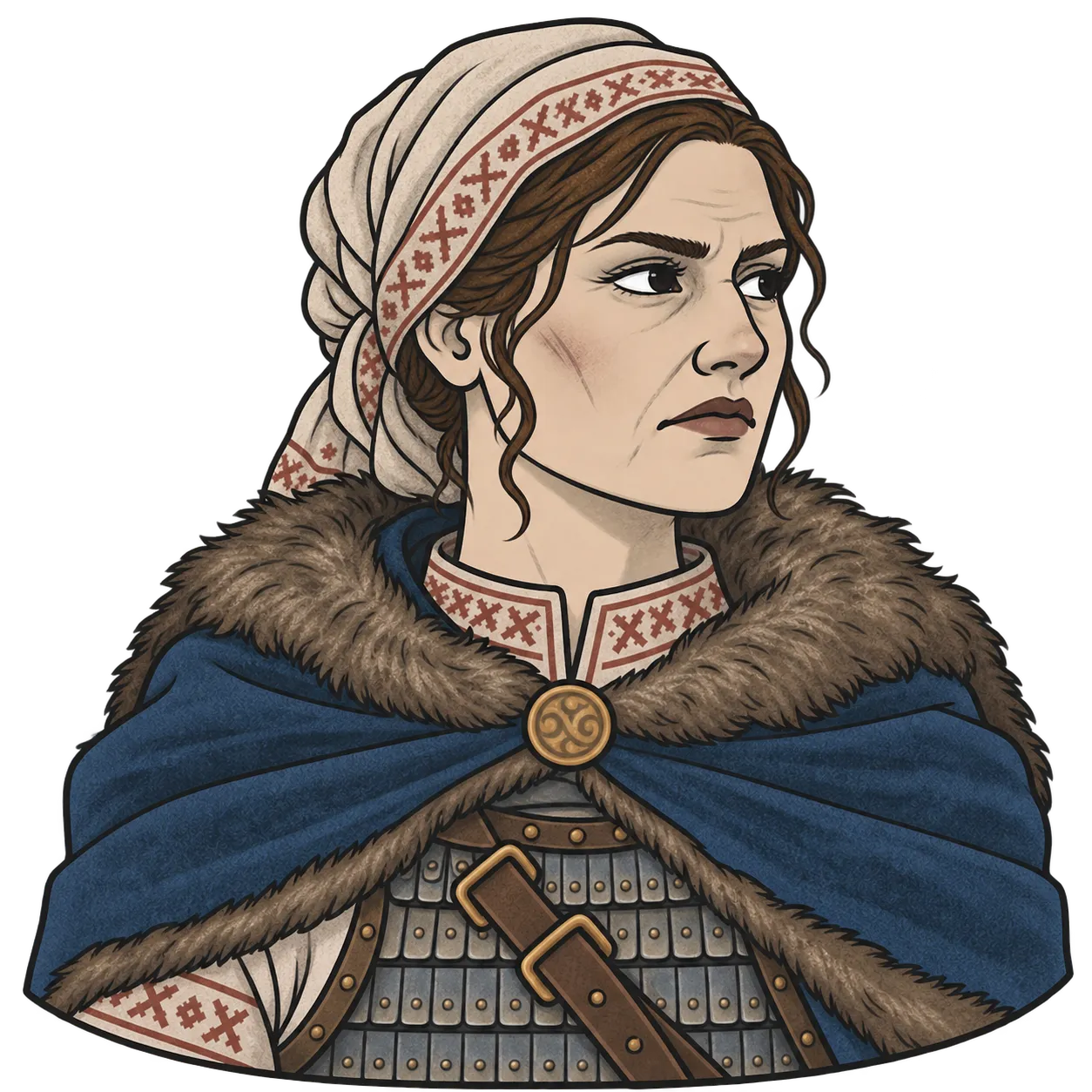
Zoryana
Mobile fighter, swordswoman and slinger
- Age
- 32 years
- Origin
- Rusaniv, a large village on the road from Kyiv to Pereiaslav
- Station
- A free woman, daughter of a well-off peasant
At a glance
A highly mobile, versatile fighter who changes her way of fighting to suit the situation. She can break through to a shooter with the sword, or break off from a stronger one and switch to the sling. But she wears no armour and cannot afford to take many direct hits, and in any single role, a dedicated specialist will outperform her.
History
Zoryana refused a good marriage, and everything else followed from that.
The groom was neither cruel nor poor. From a practical point of view the match was advantageous, and that was exactly what made her refusal so incomprehensible to her family. There was no running away in the night and no quarrel with her father: Zoryana simply said, in front of everyone, that she did not intend to spend her whole life in somebody else's household merely because it was the sensible decision for the rest of them. She was twenty-three.
Rusaniv stood a day's journey from Kyiv on the way to Pereiaslav, and Zoryana's family were the ones others came to borrow from rather than the ones who borrowed. Her father held several strips of land, horses and cattle; they had no noble standing but lived far better than their neighbours. Zoryana was the youngest child and the only daughter, and while her three brothers worked with their father in the fields she was more often given the livestock — which meant whole days far from home, driving sheep between pastures.
That was when she learned to use a sling. At first it was a child's game, then an ordinary working tool: a stone will drive off a dog, frighten a fox, bring down a bird, or turn a stray horse aside without your having to go near it. Zoryana quickly learned to hit better than her brothers. And more quickly still she understood that they did not like it.
The sword came much later. One of the caravan guards, a woman named Zhdana, stayed at their home a few times a year; seeing Zoryana drilling with a wooden stick against her brother, she showed her a few simple movements half as a joke. The next time, Zoryana asked to be shown more. It went on like that for several years.
Zhdana was not trying to make a professional swordswoman of her — she showed her what she thought would be useful for someone who might one day find herself in danger: how to keep distance, how to read the set of shoulders and feet, when to give ground and when to close the distance herself. What Zoryana liked best was not the swordsmanship but the idea that different opponents need different answers. Against a stronger person you do not have to prove you are stronger. Against a faster one you need not run faster. You have to find the thing your opponent finds awkward. That thought stayed with her far longer than any individual technique.
Her family did not approve of her practice, but did not forbid it either: her father was convinced it would pass in time. It did not pass.
After the refusal she left home properly for the first time. First she attached herself to a caravan going to Kyiv — not as a hired guard but simply as a hand. She spent more than a year in Kyiv, worked in a merchant's household, helped in a tavern for some months, then went out with caravans again. That was also when she first saw real fighting: robbers attacked the caravan on the road, one of the guards was killed almost at once, and Zoryana threw stones from behind a wheel until an attacker came too close, at which point she took up the dead guard's sword. Afterwards she could barely recall what she had actually done. She kept the sword.
Over the following years she moved gradually from casual work to permanent caravan escort, and it was there that her way of fighting took shape. She had one advantage, and it was a rare one: Zoryana understood very quickly which way of fighting to avoid.
If she faces a ranged fighter, she closes the distance and forces him to take up the weapon he handles worse. If an opponent is stronger hand-to-hand, she does the opposite: draws off, gets out the sling, and makes him do the moving. If an enemy has taken good ground, she does not necessarily try to drive him off it — sometimes it is simpler to go where his advantage means nothing. She chose a medium shield for the same reason. A heavy one would cover the approach — the most dangerous part of a fight for her — more securely, but every swing afterwards would take more effort. And she makes the dash for exactly what begins once it is over. Zoryana trades away part of her protection for the freedom to carry the fight on in her own way.
She has no armour, and it stopped being a question of money long ago. At first there genuinely was nothing to pay with: Zoryana started as a caravan hand rather than a hired guard, and nobody issued her iron. Later the money came and the wish did not. Everything else in her kit can be changed in the middle of a fight: put down the sword, get out the sling, drop the shield, leave the ground. Armour cannot — you put it on in the morning and live with it all day, and it decides in advance what kind of fight you are going to have. A good hauberk once came to her for almost nothing. Zoryana wore it for two weeks and sold it, explaining briefly: in armour she had twice stayed where she would otherwise have left.
She sees no contradiction in any of it. Sword and sling are not two separate trades she has to choose between but two tools: if one is awkward right now, take the other. Because of that she finds it hard to understand people who are too proud of the particular way they fight. She can respect a good swordsman, a good archer, a strong shieldman — but she does not see why a person should go on doing what they do best if just now it is not paying.
Over the years with caravans Zoryana has been on many roads, in several cities and in dozens of small settlements. Some companies she left after a single journey, with others she spent months, and once she travelled for nearly two years with the same group of merchants between Kyiv, Pereiaslav and Chernihiv — and that was when she first felt she could call herself a real guard rather than a hand who happened to be with the caravan. She was known as someone with no one obvious speciality who nevertheless almost always found a way to be useful. Sometimes her task was not to do the most damage but simply to be, quickly, where a few minutes earlier there had been nobody. That was what she liked most.
In a fight she is almost constantly moving. Not necessarily far: sometimes one step is enough to change the angle of an attack; two, for an opponent to lose a convenient target; a few, for a ranged fighter who felt safe a minute ago to find a sword in front of him. She does not think of a position as a place that must be held. A good position, to Zoryana, is a place that is useful now; in a minute that may be somewhere else entirely.
She and Liubava would seem to be alike: both move a great deal, neither ties herself to one place. The reason is different, and Zoryana did not see it at once. Liubava moves so that the enemy cannot build a good attack against her. Zoryana moves to find a better one of her own. One of them is going away from danger and the other towards an opportunity, and on a bad day the two look exactly the same.
None of this makes her undisciplined. If the order is to hold the gate, Zoryana will hold the gate. But if the order is not to let the enemy through, she does not in the least believe that requires standing in one place until the fighting ends.
One winter she spent in a band whose senior ranged fighter was an older man named Radovan. Before they set out each time he wanted to know what to do if the ice would not hold, if the guide lied, if the second party did not arrive in time. It wore Zoryana out: most of those troubles either would not happen at all, or would come with a way out of their own once they did. Radovan answered that a way out is prepared in advance, not found. She laughed at him at the time. Now, leaving a place somebody counted as part of the plan, Zoryana sometimes gets as far as wondering whether she is simply leaving an empty space behind her — and she thinks about it on the move, the way she always did.
It has not made her less mobile. Only slightly less carefree.
Away from battle Zoryana is companionable and easy among strangers. She likes questioning people about places she has not been, and takes an interest in trade roads, towns and other people's customs; she can listen for hours to an account of a city she has never seen and by the next morning be asking how many days it takes to walk there. She adapts to a new place quickly: finds where to buy food, who knows the local road, whom it is better not to approach, and when it is time to move on. In nearly ten years on her own she has learned to enter a new setting so easily that she sometimes fails to notice how unusual that is for other people.
About her own family Zoryana speaks far less often — not out of shame. The opposite. She knows perfectly well that she could go back: her father, most likely, would no longer be as angry as he was, her brothers would mock her anyway, her mother would cry, but the door is not shut to her. Over these years she has come home several times, briefly at first, then staying longer. She no longer treats going back as a defeat. She still cannot stay for good: the mere possibility of leaving still means too much to her.
Her things are always packed. Not because she is expecting a raid — it is simply calmer that way; by the time a conversation reaches “are you staying or going”, Zoryana has been ready to leave for half a day, and she is the last to notice it. In a fight that same knack often saves her life: if one method is not working she tries another; if a position has gone bad she changes it; if the enemy has gained an advantage she looks for ground where that advantage disappears. Outside a fight the same approach works far worse. An unpleasant job can be changed. A bad contract left. An uncomfortable place abandoned. There was a time when Zoryana added people to that list just as easily.
Not so much now. Over her years on the road she has understood, several times, that some things become hard without having stopped being right. She is still convinced that a person should not let circumstances or other people's decisions determine their whole life — she simply knows now what that conviction costs. Her own door is still open, and most of the people she shares a fire with have no home at all. That is the part Zoryana tries not to say out loud.