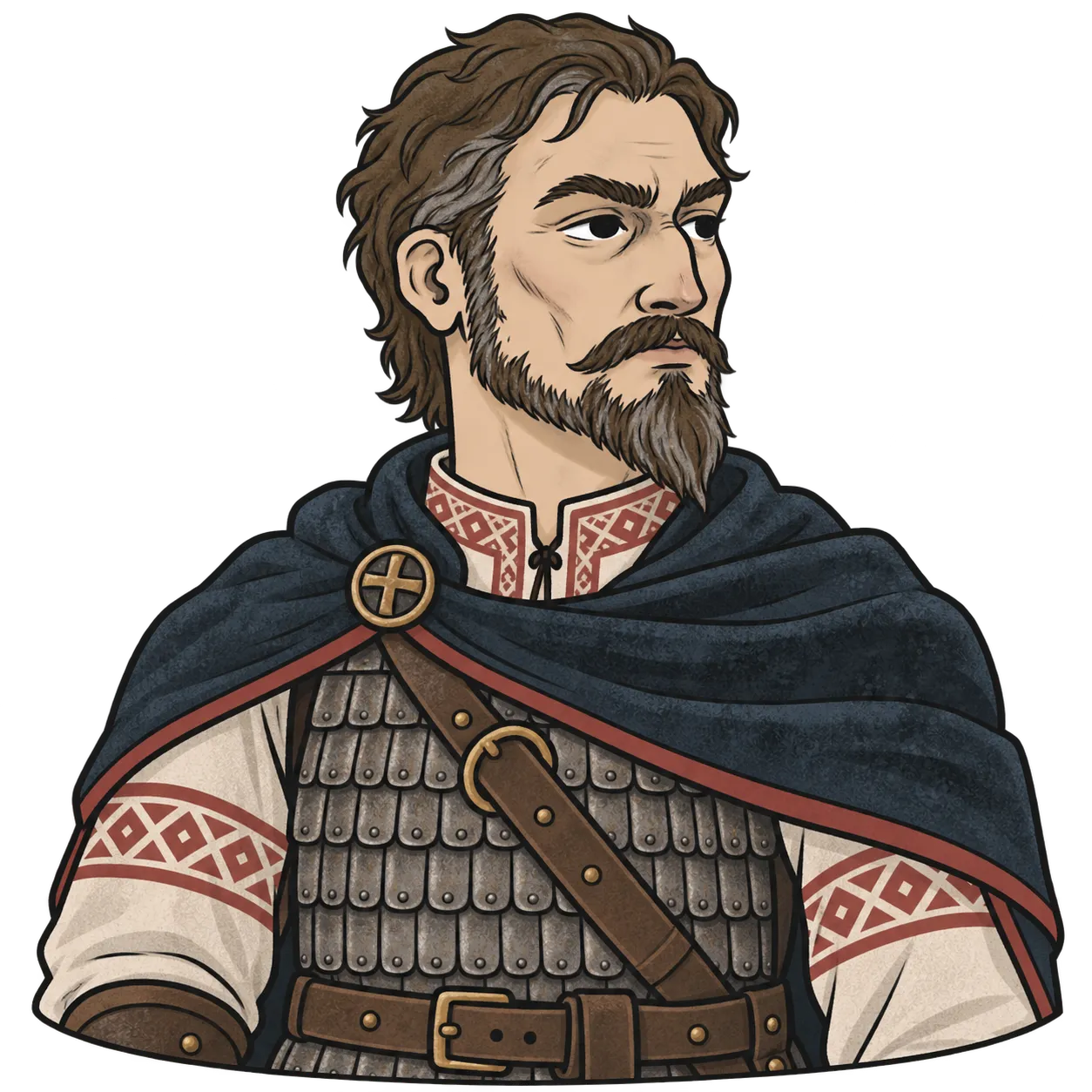
Hlib
All-round first-line fighter
- Age
- 35 years
- Origin
- Bilhorod on the Irpin
- Station
- A free man, a craftsman's son
At a glance
A versatile front-line fighter who is at his best with a shield. With heavy shield and sword he holds ground solidly; mace and medium shield give a more active fight and break defences better. He cannot match a specialist in any one role, but he fills whichever role is needed.
History
Hlib grew up among shields long before he carried one into a fight.
In Bilhorod his father worked in wood: the parts of carts, hafts for tools, shields for the town watch. The metal fittings were ordered from a smith and the rest was made at home, out of wood, leather and strapping. The family lived plainly but securely. Hlib fitted grips from childhood, mended shields, and by his teens could tell which shaft would split at the first hard blow and which would last a few more years. Soldiering interested him hardly at all.
That changed when he was sixteen. A prince's retinue passed through the town and urgently needed several dozen new shields and repairs to their gear. The soldiers lived beside the workshop for almost a fortnight. Hlib helped his father and saw retainers for the first time not in a ceremonial entry but in their ordinary life: worn out, filthy, with torn straps, blunted swords and old scars.
What struck him was not how they fought. It was how ordinary the work was to them.
A few years later he joined the town watch. He was never a quick learner. But what he had once learned he did not lose again: if an older man showed him how to hold a shield, the next day Hlib held it right; if he opened his flank in a practice bout, the next time he remembered.
He chose the sword not out of any fondness for it but because it was the most versatile weapon available. Hlib does not regard a weapon as part of himself at all: a good sword is a tool that does its work reliably enough. He thinks of the mace the same way.
The shield, though, was never secondary to him. It is the shield that most often decides how a man has to fight. A heavy one lets him take the push and hold ground another fighter would already have given up — only every blow from behind it costs more and is less likely to land. A medium one leaves more freedom to the weapon itself: the strikes are cheaper and more accurate, though the cover is markedly less. So if a position has to be held, Hlib takes the heavy shield and the sword; if he has to press the attack, the mace and the medium shield. He does not think either is better than the other. They are simply two ways of doing the same job.
His armour is medium, and that too is a choice rather than what he happened to get. Heavy armour would make the second approach pointless: with mace and medium shield the whole idea is to move and press, and in full iron Hlib would simply become a slower version of himself with the heavy shield. Light armour would not offer enough protection for the first. He needs gear in which both options stay open — and he would rather be slightly worse at each than good at one and useless at the other.
From the watch he was invited into the small retinue of a local boyar. That was where the real fighting started: caravans, tribute-collectors, bandit companies, skirmishes between small armed bands. Hlib quickly earned a reputation as a man you could trust with a difficult position. A gate had to be held — they put Hlib on it. Untrained levies had to be led somewhere — they sent Hlib. A gap opened in the line — he turned up in it. He was seldom the first man named after a victory, but the captains knew his name well.
He never had particular ambitions. He did not want a command of his own and did not dream of wealth or fame. He liked a plain, comprehensible thing: there is a task, there are people beside you, each knows his place, and together they do what needs doing.
Which is why the thing that made him leave the service hit him harder than he is willing to admit.
The retinue was ordered to a village whose people were accused of holding back part of their tribute. The task looked ordinary: find the headman, take what was owed, bring a few people back for questioning. Hlib was ordered to block the road out and let nobody through.
He carried out the order. He did not see what was happening in the middle of the village — he heard shouting, saw smoke and several people trying to get away. One man he turned back at swordpoint. A woman with two children he also refused to let past.
Only later did it emerge that the search for hidden property had turned into looting. One of the houses caught fire. Several villagers were beaten, two died.
Hlib killed nobody. He set nothing alight. He was not even present where the violence began. He simply stood on the road and did not let people leave.
The captain did not think anything extraordinary had happened: the retinue had its orders, the village was punished, part of the property was taken. Hlib left the service two days later.
For some years after that he hired on escorting merchants and small parties, avoiding permanent service under any one master. He did not become an enemy of discipline and did not start thinking every order evil — quite the opposite. Hlib is still convinced that without discipline an armed band very quickly becomes a crowd of people with weapons. He simply listens a great deal more carefully now to what exactly he is being ordered to do.
In battle he is calm and predictable. He does not chase the weakest enemy, does not try at any cost to land the biggest blow, and rarely risks his position for an impressive manoeuvre. His advantage is reliability. He has a good sense of when to become a wall and take the push, and when the answer is pressure of his own. He can take several blows, but does not consider that proof of courage.
He does not like fighting alone. He is at his best when he can see who is covering him left and right and where his neighbour will fall back to if it goes wrong.
Some years ago he spent a winter serving in the same band as a spearwoman named Melania, and they did not get along. Melania distrusts almost by instinct anyone who explains his decisions by an order, and Hlib was the living example. Hlib saw in her history the opposite danger: the certainty that one person has the right to decide for a whole band what is worth dying for. Their arguments would start with a specific situation in a fight and very quickly stop being about fighting at all. They parted having proved nothing to each other.
With Velemyr it went differently, and worse. He too obeyed an order to fall back, and he too does not think the order was wrong. The difference is that Velemyr buried his wife afterwards and Hlib buried nobody. They served together a whole summer and never once spoke of it. Each knew exactly what the other was not saying.
Hlib is neither silent nor grim. Away from battle he is calm, good-natured and even slightly dull. He likes working with his hands, mends small things willingly, and does not understand why anyone throws away an object that can still be repaired. In camp he is forever tightening, tapping or straightening something; somebody else's badly fastened strap irritates him more than an insult. He drinks little but likes long talk by a fire. He remembers people well and almost never forgets a promise. Nobody would call him witty, yet in a flat voice he will occasionally say something so absurd that it takes his listener several seconds to realise Hlib was joking.
He is not afraid of responsibility and does not want to command. Put him in charge and he will do it conscientiously. He will not ask for it.
He has one weakness: he needs clear rules more than he can afford to. When a situation is ambiguous and there is no right answer, Hlib can spend far too long looking for the line between what he is obliged to do and what he is personally prepared to answer for. Once he told himself far too easily that he had only been carrying out an order. Now he sometimes goes to the opposite extreme and tries to foresee the consequences of every decision in advance.
He carried out the order, and he had the right to carry it out. One thing Hlib still does not know: was it possible to stand on that road and not be part of what was being done behind him? He does not ask it out loud. But that question decides a great deal more of what he does than he is willing to admit.