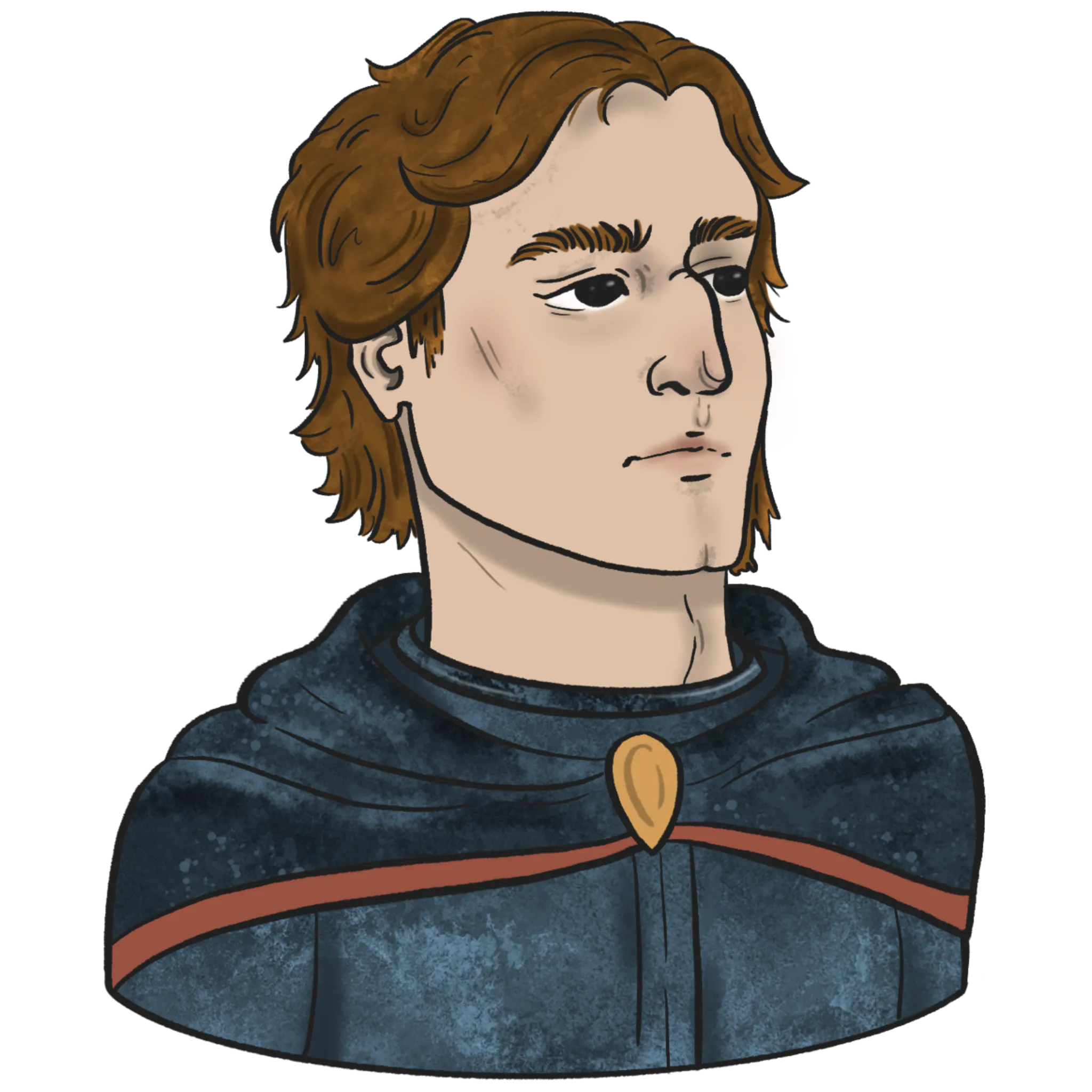
Leader
Liutobor
Shock fighter and formal heir of the fallen commander
- Age
- 23 years
- Origin
- A boyar's seat on the Zdvyzh in the Kyivan land
- Station
- A voivode's son, a junior man of an influential house
At a glance
A front-line shock fighter who changes style to suit the situation. The spear lets him reach the enemy first and work through their ranks; sword and shield carry the fight on at arm's length. He can do more in a turn than most, but his aggressive style and middling protection leave little room for error in a drawn-out fight.
Through the leader's eyes
Liutobor wants raiders to fear attacking frontier villages again. Defeating the Tati is not enough — people must hear of the victory. He is ready to give his word, share the spoils and step forward when people need someone to follow. His father's banner is already in his hands. Now he wants them to remember the man who carries it.
History
Liutobor still remembers his hands shaking after his first battle, and is still convinced nobody saw it.
He was sixteen. He did not run, he let nobody down, and he even, it seems, wounded somebody. And then he sat behind a cart for half an hour waiting for his hands to stop. Ever since, Liutobor goes in first — not out of courage, but so that nobody has time to notice him hesitate.
He is the only son of the boyar and voivode Mstyslav, who served the prince of Kyiv for many years. His mother came from another wealthy house and died when the boy was nine; after that Liutobor grew up mostly among his father's retainers. He learned to ride before he learned to read properly. He knew the rules of the prince's court and could carry himself among boyars, though learning irritated him almost always: he took in only what he could try with his hands at once.
His father prepared him for service and was in no hurry to give him real responsibility. He thought his son able but unrestrained and too dependent on other people's admiration. Liutobor heard mostly criticism from him and almost never approval. He is still not certain his father was wrong, and that is exactly why he cannot stop thinking about it.
Mstyslav was killed in the spring, on the same frontier the warband is heading for now. He was killed unremarkably: chasing one of the small bands of Tati, by an arrow loosed by somebody whose name nobody ever learned. This warband was his — he raised it, paid it and led it for longer than Liutobor has been alive. By custom the banner passes to the son.
Liutobor took the banner. Nobody objected. That is not the same as agreeing.
He did not take up the spear because it suited his nature. Quite the opposite. The spear is a weapon of the line; it demands that a man stand still and wait for the enemy to walk onto the point, and waiting is the one thing Liutobor cannot do. But the spear has a property he put up with everything else for: it reaches first. While the rest of the line is still closing, he is already at work.
His whole fighting style grew out of that. Liutobor does not hold his spear like a fence. He presses forward with it, strikes through the enemy's ranks, scatters the men who have not yet closed up, and forces the other side to deal with him instead of watching where the warband is going. It is conspicuous. It is almost always conspicuous. And Liutobor has never pretended he did not care.
He takes up sword and shield when the spear has no room left to work: when the fighting is at close quarters, when the shaft has been caught, or when he simply has to stand in line and hold. He handles them decently — his father's retainers drilled him from the age of seven, and the drill itself is good.
His armour is medium, and so is his shield — at his father's seat on the Zdvyzh he could have had any. Liutobor wore heavy harness for one summer and gave it back. Not because of the weight: in it he reached the enemy second, and his whole way of fighting is built on reaching them first, before they can close up. He chose the medium shield for the same reason: protection is worth having to him only while it does not cost him too much tempo. A heavy one would hold better, but Liutobor builds too much on the first blow and the action after it to pay for that every time. He trades away part of his protection deliberately, to be where he is not expected yet. And he understands perfectly what it will cost him if he is expected after all.
The trouble is that a fight with sword and shield is a patient fight. It is won not by a single blow but by whoever keeps his head longer. Liutobor goes to the sword earlier than he should, because standing behind a spear and waiting feels to him like doing nothing, and he cannot bear doing nothing for a minute. An experienced opponent sees this and waits for exactly that.
He is open, loud and makes friends easily. He remembers the names of common soldiers, eats with them, and does not shirk dirty work. Generous — especially when there is a chance to be generous where it shows. He loves contests, songs and noisy arguments. He sings badly but with conviction. He cannot stay angry over small things and is usually the first to make peace.
Ratybor served the father longer than anyone and has not said one word against the son commanding. He simply does what he has always done: checks the straps, sets the watch rota, decides where the line will stand. And the men, as before, come to him with their questions. Nobody is undermining anybody. It is only that one man gives the orders and another is the one obeyed, and both of them know it.
Which is why Liutobor takes a remark from Ratybor harder than from anyone. Ratybor speaks to him levelly, briefly and to the point — exactly as he would to anyone — and that is what is unbearable. Praise would mean the old man had acknowledged his right to command. A quarrel would mean the right exists and is being denied. His even tone means nothing at all, except that Ratybor has not decided yet.
One summer he campaigned in the same band as a hammerman named Borymyr, as young as he was and twice as silent. Borymyr did the same things Liutobor did: went in first, struck at the most dangerous man, took more risk than the others. The difference was that he was entirely indifferent to whether anyone saw it. Liutobor spent three months trying to work out whether Borymyr was pretending. He never did work it out. It remains the most uncomfortable memory of that campaign.
One other person spoiled his mood for longer. Escorting a caravan, he spent some weeks alongside a fighter named Zoryana, who fought now with a sword and now with a sling depending on which was more convenient that minute, and saw nothing in it worth discussing. Liutobor tried to explain to her that a good fighter ought to have a style of his own. Zoryana answered that a style is what makes you easiest to predict. He still thinks she is wrong. And still, going in from the same side for the third time running, he remembers that conversation.
When his father first gave him a small forward party to lead, another company worked alongside them for a few weeks. Melania, out of that company, Liutobor does not remember. She does remember him.
He has two half-sisters from his father's second marriage. He is warm with the younger and quarrels endlessly with the elder. His father's second wife was never a mother to him, yet she is the one who defends his right to the inheritance — and not out of affection. The seat, the land and the house's standing with the prince are being contested by his father's brothers: the house is large, Liutobor is its youngest man, and a twenty-three-year-old heir who has moreover ridden off on campaign suits absolutely everyone except himself. His stepmother takes his side because her own standing would go down with his.
Everything good he does, he does where it will be seen. He divides plunder in front of everyone. He gives a wounded man his horse in front of everyone. He goes in front exactly when the man in front is being watched. Each of those things is right in itself, and not one of them can Liutobor do quietly. Telling his own generosity apart from the wish to have it noticed is something he gave up attempting long ago.
He is not cruel and does not reach for power for its own sake. He is simply certain he is capable of more, and mortally afraid of living out his life in his father's shadow. So any chance to prove his worth becomes instantly personal. His father, incidentally, thought the same way, and also went in front. That is exactly where he was killed. That resemblance is the one thing Liutobor does not notice.