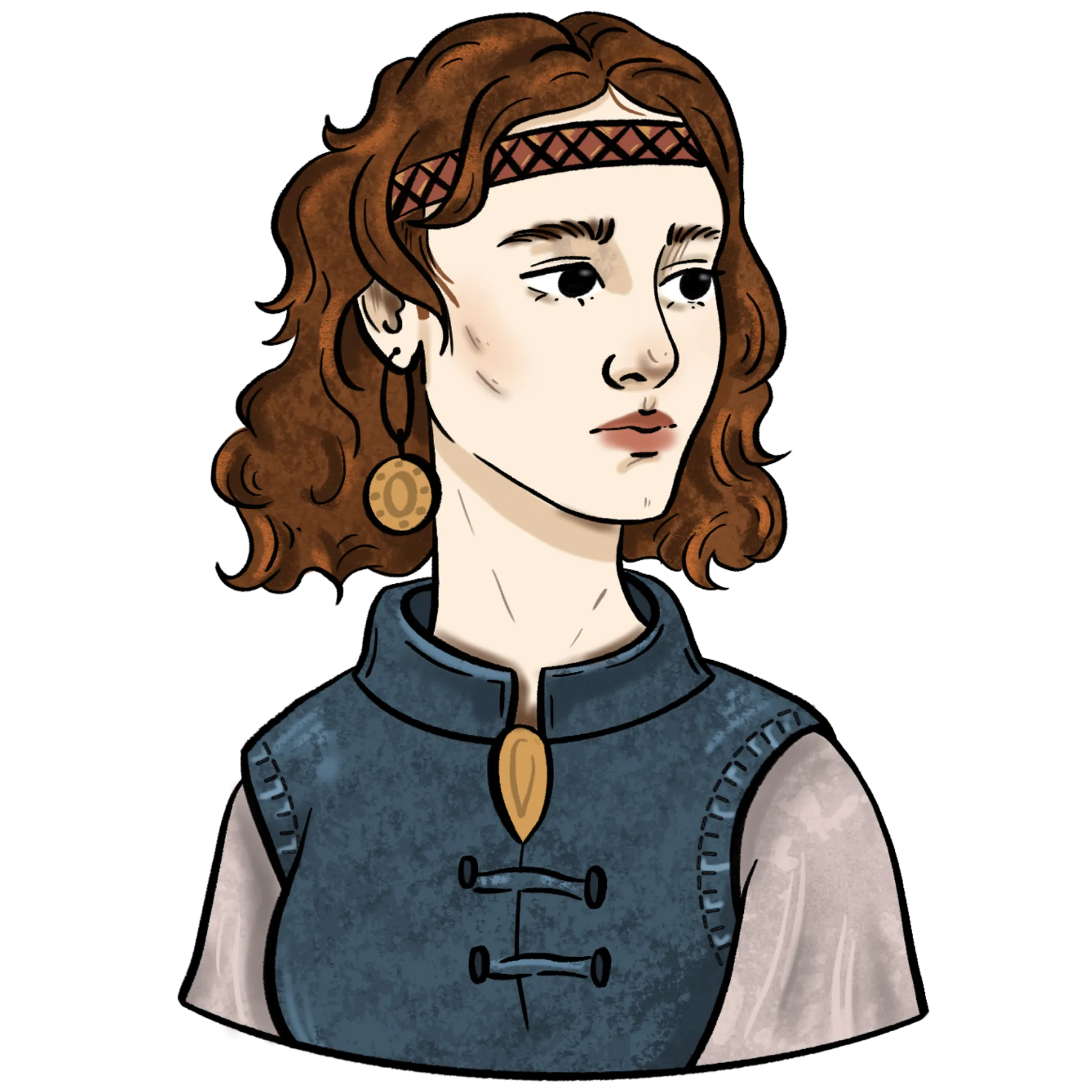
Leader
Dzvenyslava
Archer, scout and guide
- Age
- 28 years
- Origin
- Tumashch, a frontier settlement on the Stuhna
- Station
- A free woman, of no boyar house
At a glance
An accurate archer who controls a fight from range. She is at her best when she can choose her position and shoot without pressure. If an enemy closes to arm's length, she is markedly weaker than a dedicated melee fighter.
Through the leader's eyes
Dzvenyslava wants to understand where the raiders' tracks lead and whom they depend on. Roads, stopping places and news give an advantage to whoever knows more about them. She trusts promises of safety less than the freedom to choose another path. There are people in the warband she chooses to stay for. Someone chose this road for their escape. She is curious why this road in particular.
History
Dzvenyslava is always the first to spot the most dangerous thing on the road. That is not a gift but twenty years of habit: she is the only one in the warband who notices when the grass on the verge is pressed the wrong way. The second most dangerous thing on that same road is that she does not always mention the first. That one she does not count as a danger at all.
It began with her father's traps. He hunted, guided merchants and knew the roads between Kyiv and the steppe march better than the men who collected tolls on them. Her mother treated simple wounds and held the household together while her husband was away for months at a time. Dzvenyslava went with her father from childhood: tending horses, setting traps, learning to find her way where there was no road. The bow in that life was a tool, not a weapon. She learned to shoot long before she first saw why anyone would shoot at people.
Tumashch burned when she was seventeen. Her father and elder brother died that night. Dzvenyslava got her mother and the younger children to the city; her mother died of sickness the following winter. A craftsman's family took her sister in. Her younger brother vanished a year later in a raid on a caravan, and she still does not know whether he was killed or sold on to the south.
She tells none of this. To a direct question she answers briefly or turns the conversation back on whoever asked. Dzvenyslava can walk beside someone for half a day, learn everything about their family, and say nothing about herself that could not afterwards be forgotten.
In the years after the city she made her living escorting caravans. She was not paid for her shooting. Others shot better, and she was the first to say so. She was paid because caravans with her were less likely to end up in a fight at all. She knew where not to make camp. She saw the tracks of riders on hard ground. She could talk to people in the border villages so that they said more than they meant to.
She joined the warband as a hired guide. On one campaign the warband lost both its scouts, and Dzvenyslava went ahead alone without asking leave. She saw the ambush in time. Afterwards she was asked to stay.
In battle she does not trade shots from the first convenient spot. First she looks for the line from which the field is easier to see and she is harder to see, and she goes around a shielded enemy rather than spend arrows on his shield.
The scramasax was always a working tool — to skin game, cut a rope, whittle a stake. She learned to fight with it later and still does not think she can. She brings out the scramasax and the light shield together, and only once it is too late to shoot. The shield is not there to win the fight: it buys exactly the time she needs to wound him, gain a step, and open the distance again. Dzvenyslava has no intention of beating anyone at close quarters — she intends to leave.
Her armour is light for the same reason. A scout walks, climbs where a horse will not go, and covers more ground in a day than the warband does in two. Heavy armour would have given Dzvenyslava protection in exactly the fights she has no intention of entering anyway, and taken away the thing she lives by — being able to go forward and come back the same day.
Away from battle she is tidy but not domestic. She keeps nothing she does not need, sleeps lightly, and stores her gear so she could leave within the half hour. Before setting out she checks bowstring, arrows, knife and saddle straps — every time, even when she checked an hour ago.
She is clever, watchful and not always pleasant. Cutting. Too direct. Impatient with people who hesitate long. She has no patience for solemn speeches, princely ceremony, or orders whose reason nobody explained to her.
With Ratybor she is oddly at ease, and that irritates her. He is older, he served twenty years under banners she would not have served under, and he is still looking for an order to lean on. Dzvenyslava looks for nobody's. Yet it is to him she reports when she returns from scouting, and not to the man who holds the banner — and she has never been able to explain why, to Liutobor or to herself.
Some years ago she ran a caravan alongside a young fighter named Yanka. They parted badly. Dzvenyslava held back word that the road ahead was being watched: she judged the caravan would take that road regardless, and that fear would help no one. Yanka found out in the middle of the fight. Since then Dzvenyslava has known at least one person who does not forgive that — and it has changed nothing in how she decides.
Because she takes silence for a form of protection, and that is where she goes wrong. She sincerely believes she is taking the risk herself. What she is actually taking is the right to decide whose risk it is.
Dzvenyslava does not want to command and is poor at following orders she considers senseless. Her loyalty belongs to people, not to a post, a house or a banner. The people she is loyal to are usually the last to be told.