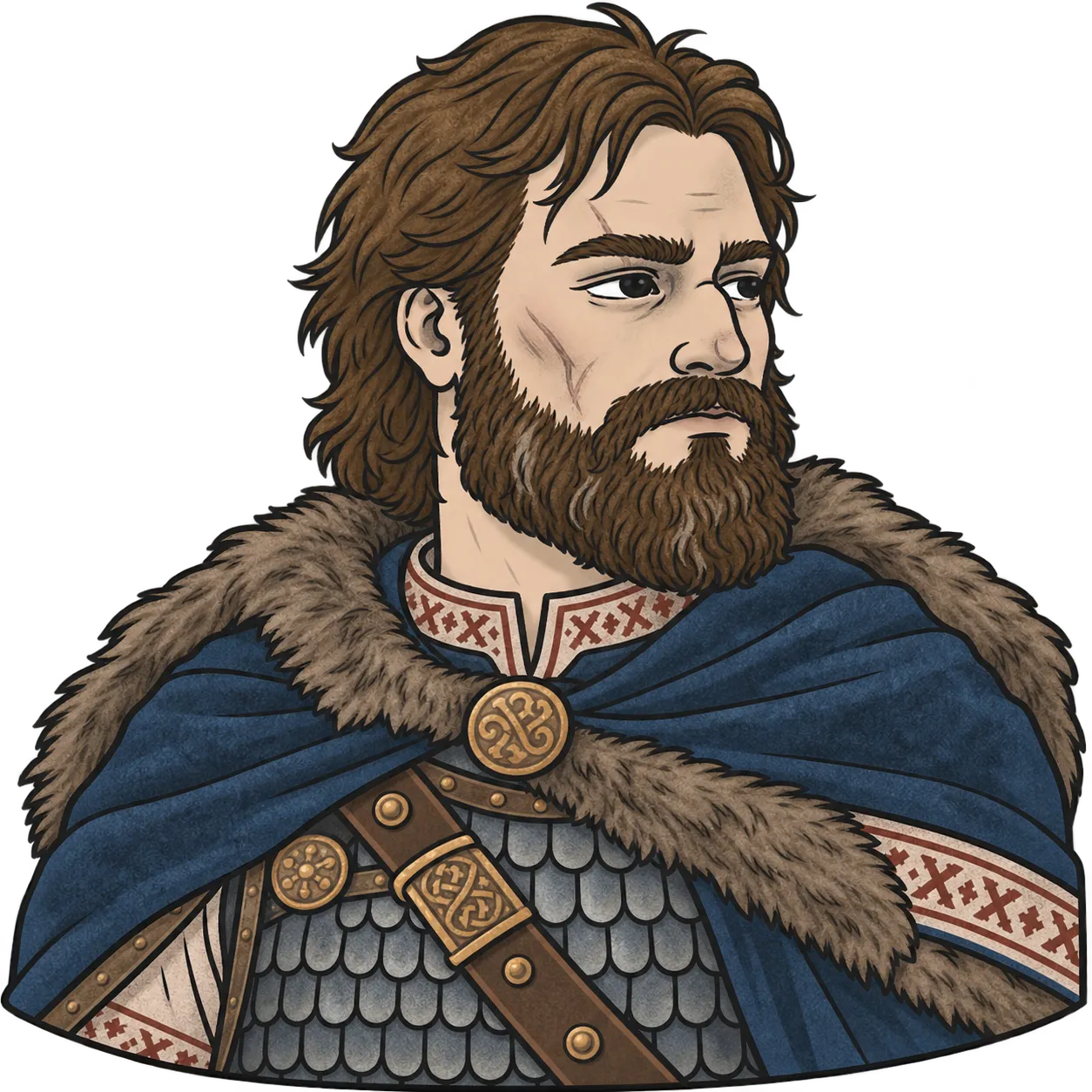
Borymyr
Heavy striker, first-contact fighter
- Age
- 21 years
- Origin
- Baruch, a settlement north of Pereiaslav
- Station
- A free man, a hired labourer's son
At a glance
An unarmoured assault fighter. His hammer deals a heavy blow to one target; his axe can reach several enemies standing together. He is best with a running start and his own choice of when to close, but has almost no protection against a return blow.
History
Borymyr came by his hammer because nobody else wanted to take it.
It happened on the road outside Baruch when he was seventeen. A man from a prince's escort travelling with the merchants was killed in the skirmish. His gear was collected after the fight, but everyone stepped around the heavy hammer: awkward, slow, and it took too much out of you. Borymyr took it.
His family had no trade of its own. His father hired out: digging, carting, setting fences, going with a gang to mend other men's gates and re-lay other men's roofs after a fire, a raid or a storm. In and around Baruch there were plenty of such steadings, and not one of them was theirs. Borymyr was taken along as soon as he could hold an axe, and was paid as a grown man before he was one — because he worked like one.
For a long time this did not trouble him. He was good with wood, could raise a wall, fit a wheel, cut a mortise, and do in a day what took others two. He had little patience for that kind of work: where a master would spend an hour easing a joint into place, Borymyr more often tried to settle the matter with a harder blow. Sometimes it even worked, and then he was praised for it as well.
For the first months he used the hammer badly. He tried to strike as often as he had with an axe, wore himself out fast, and several times nearly took a blow in return when he could not bring the weapon back in time after a swing.
Then he understood that a hammer does not forgive haste. The answer is not to strike more often. What matters is reaching the place where a single blow will make the greatest difference.
That thought changed more than how he held the weapon. Borymyr began watching the field more, waiting for an enemy to turn towards somebody else, looking for the moment when he could take a few quick steps and put his whole body into a blow. His shoulders are not the broadest in the warband. Borymyr's strength is in how he gathers speed, not in how much he can lift.
He never gave up the axe either. He has worked wood with one since childhood, and takes it into a fight when several enemies stand close together. With a broad swing he tries to reach several at once; he keeps the hammer for the man who needs bringing down with one blow. He takes advice to change weapons calmly. Advice to give up a target he has already chosen goes down much worse.
At first he had no armour because he could not pay for any. Later, when the money was there, he went out a few times in borrowed harness. After one fight what stayed with him was not the blow the armour had taken but the man he had failed to reach while he was still standing open. Since then Borymyr would rather risk a counterblow than miss his chance to strike.
He does not like standing in front of a man and trading blows. If a fight has turned into that trade, Borymyr reckons he has already done something wrong. What he does best is strike a man who is busy with someone else, who has only just reached the line, or who has not yet understood that he has been chosen.
Even so, he does not finish the wounded simply because they are easy to finish. The opposite: Borymyr almost always looks for the most dangerous enemy who can still be stopped with one blow. It makes his choices look foolish at times — while the others are finishing a man who can barely stand, he walks past him towards a fresh fighter in good armour. He explains it simply: a weak man can be killed afterwards, but a strong one must not be allowed to do what he was about to do.
In the last few years he has served in several small bands that guarded roads, escorted people, or helped the local authorities drive Tati off the roads. He never stayed long in one place — not through quarrels or a bad name, but because when the work ended he moved easily to the next. He did not think a few months of campaigning together automatically made people kin.
Once that cost him a friend.
In the band Borymyr stayed with a little over a year there was a former retainer named Dobryn. They often fought side by side and understood each other without words. After a hard skirmish Dobryn took a wound in the leg and could no longer march with the band. Staying would have meant losing a good contract. Borymyr left.
He left his friend part of his money, arranged with a local family to look after him, and was certain he had done everything right. When he came back a few months later Dobryn was gone: he had recovered after a fashion and gone his own way. They never met again.
Later Borymyr heard by chance that Dobryn had settled in Kyiv, on the Podil. It was also said that before the injury he had been teaching some girl from a caravan guard there how to hold a short blade. By all accounts, his leg never did straighten. Borymyr did not go to see. He is still not sure whether that was laziness or something else, and he does not like it when a conversation reaches that point.
For a long time he did not understand why the story troubled him. He had left a wounded man with money and an arrangement, and the arrangement had been honest on both sides. Only in time did he begin to suspect that not everything between people is an agreement.
Away from battle Borymyr is plain and undemanding. He can sleep anywhere, eats what there is, is indifferent to clothes, and almost never buys a thing he does not intend to use. But he knows wood and repair: in camp he spots a cracked wheel, a bad prop, a loose handle or a crookedly driven peg at once, and usually mends it himself and tells the owner afterwards.
With older men it can be hard as well. He once spent half a year under a shooter named Radovan, who had a backup plan for every situation and, for every backup plan, another one. It drove Borymyr to fury. What drove Radovan to fury was that Borymyr decides once and for all. Both survived that campaign and neither changed his mind.
He is companionable but not open: he laughs easily, keeps a conversation going, is comfortable among all sorts of people, and almost never speaks about what actually troubles him. He has the confidence of a man who found very early the one thing he is genuinely good at, and because of it he sometimes behaves as though he has worked out the rest as well.
He does not like people who take a long time preparing for a decision that is already obvious, and is particularly irritated when somebody keeps arguing only because he is afraid to take responsibility.
Outside Oster, Borymyr picked a spearman out of the enemy line and went for him. Two men turned towards him on the way; Borymyr saw both of them and did not stop. He reached the spearman, and his shoulder had been slashed halfway there. After the fight he was asked whether he had seen those two. Borymyr said he had. He said nothing else, and nobody could tell whether that had been an answer.
Outside a fight the same thing costs him more. Having decided once, he leaves earlier than he should, says the thing that cannot be taken back, or refuses something simply because he decided once that he did not need it.
He walked away from Dobryn. He did not go to Kyiv afterwards either.