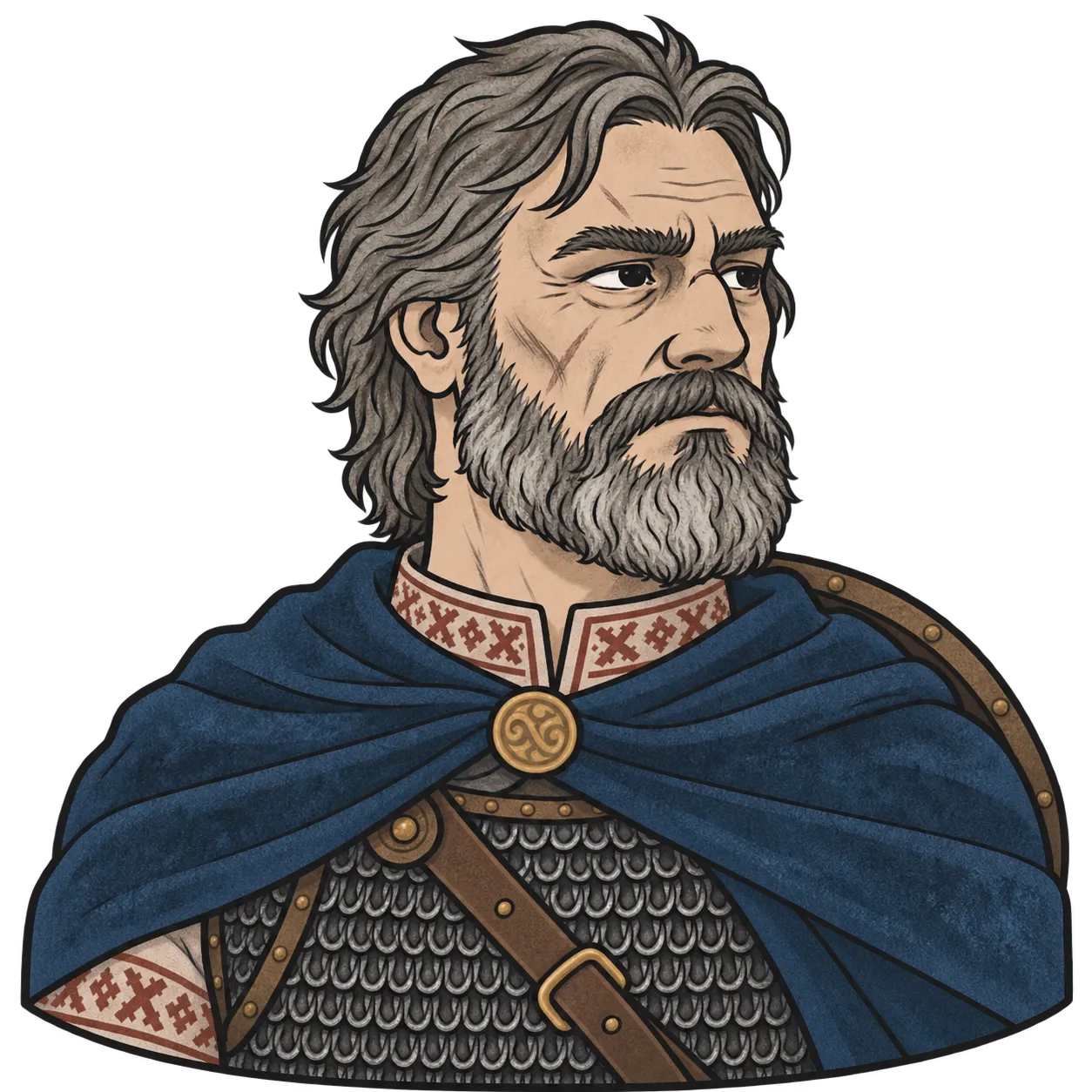
Radovan
Heavily armoured shooter, anchor fighter
- Age
- 47 years
- Origin
- Moroviisk on the Desna, on the road from Kyiv to Chernihiv
- Station
- A free man, son of a prosperous householder
At a glance
A steady shooter in heavy armour, able to hold a position under fire for a long time. The fustibal delivers crushing blows that are highly effective against armour and shields, though a small stamina reserve forces pauses between throws. Up close he takes sword and medium shield, but melee is not his trade.
History
Radovan always knows how much of the camp's oat supply is left.
This is not a virtue, nor even a landholder's habit, though a landholder is what he was. It is the same trait that makes him look, every night before sleep, at where his sword is lying.
He grew up in a large steading outside Moroviisk, on a road travelled almost daily by merchants, wayfarers and small companies of soldiers. His father had land, horses and several carts, and made his living from more than the farm: giving people a place to sleep, changing their horses, helping move goods further north. Radovan was the eldest son and knew from childhood that the steading would come to him in time. His father taught him to count sacks of grain, to check wheels before the road, and not to trust a man merely because he was well dressed. What was expected of him was not feats but the ability to keep a household in order, and for a long time that suited him entirely.
The road brought him into contact with weapons. Caravans sometimes stood in the yard for days, and guards from various lands stopped with them. Radovan first saw a fustibal in the hands of an old mercenary escorting merchants from the west, and the weapon struck him as absurd — long, awkward, needing far more room than an ordinary sling. The first stones he tried to throw went everywhere except at the mark.
Which is exactly why he kept at it. It always irritated Radovan when he could not understand how something worked.
The old guard stayed in their yard for nearly a month with a broken leg. In that time Radovan learned to seat the stone properly, to feel the moment of release, and not to try to correct a bad swing with the strength of his arms. He did not become accurate at once, but he quickly grasped the fustibal's chief advantage: choose the right place and you can begin the fight before most opponents can strike back. He liked that thought.
When Radovan was twenty-six his father fell gravely ill. For the next several years he barely left the holding and gradually took over all the family's affairs, and after his father's death the steading passed to him. And it was then that the thing happened which Radovan later called the greatest mistake of his life.
Travellers were robbed several times nearby. People spoke of Tati gathering in small bands along the road. The neighbours proposed setting a joint watch, but Radovan refused: it seemed to him that the raiders were looking for easier prey and would not come at a large steading where there were always plenty of people.
The Tati came at night. They could not take the holding quickly, but they set fire to two buildings and tried to drive the household into the yard. Radovan got a defence organised in time: he hurled stones with the fustibal from behind the fence as they came on, and when they reached the gates he took up sword and shield. The attack was beaten off. One of his younger brothers was killed.
After that Radovan never again said that some particular danger was unlikely to happen.
He left the holding to another brother. The family took it at first for a temporary decision, and Radovan himself said he would be gone only a few months: he would find the band of Tati working the district, help make the roads safer, and come back. He did not come back. Many years have passed since — caravans, toll posts, town gates, watch posts and short campaigns. He changed companies far more rarely than he would once have changed a job: if he has found people he can trust, or commanders who do not do stupid things for no reason, Radovan would rather stay.
The longest he stayed anywhere was under a retainer named Boryvoi, who did not start a fight without cause and thought about the line of retreat before the fighting began. Radovan still considers him the best commander he ever served under. That anyone could have failed to get on with such a man is, to him, still a mystery.
Over the years of service he has seen enough young soldiers faster and stronger than he was, and far better with a sword. He has outlived many of them. It did not make him braver — rather the reverse. Radovan believes less and less in a situation where one will somehow scrape through, and values more and more the plain advantages: a good position, solid armour, stones enough, and a comrade who will actually be standing where he promised to be.
He did not start wearing heavy armour out of any love of hand-to-hand. The opposite: he understood quickly that a fustibal makes him a conspicuous target. Archers tried to make him leave his position, slingers answered with stones, and those who could not reach him at range simply came forward. Radovan did not want to spend his strength on constant withdrawal, and armour let him stay where the field was well in view. With age this has come to matter more still: he long ago stopped trying to be the most mobile fighter in the warband, and tries instead to decide correctly, once, where he is going to stand.
In a fight he almost always begins with the furthest target that can actually strike back. The nearest opponent interests him little if he will not be a danger for a while yet; instead Radovan looks for archers, slingers, javelin-men and the people behind the main line. He does not consider himself a better shot than a good archer. He simply tries to start shooting earlier.
The fustibal takes a great deal of strength, and Radovan does not hold the same tempo through a whole battle: after a hard throw he may wait, read the field, and only then prepare the next. Younger shooters sometimes take these pauses for slowness. Radovan calls it an unwillingness to run out of breath before the enemy does.
If an opponent does reach him, he puts the fustibal aside, takes up sword and medium shield, and stays where he is. A medium one, specifically. A heavy one would cover better, but it would weaken his counterblows with the sword further still: what Radovan needs is not only time behind the shield but the ability to strike back hard enough that an opponent cannot hold him in close combat with impunity. The moment the space in front of him opens again, he goes back to the fustibal. The sword is not a second speciality for him: he does not like duels and almost never seeks close combat himself. His task is simpler — not to let an opponent get past him quickly. The armour takes what he failed to avoid, and the shield buys time. Even when several of them reach him, Radovan does not give up the position at once — but he understands perfectly that from that moment time is working against him.
Away from battle he resembles a landholder far more than a professional soldier. He is forever counting stores, remembering who was issued what, and getting irritated when good things spoil merely because they were stored wrong. If something has run out in camp, Radovan almost always knows before anyone else — and is particularly annoyed when the younger men call it grumbling and then come two days later to ask where to get a spare strap. Radovan usually knows. He is careful with people: he does not trust a first impression, listens more than he speaks, remembers small inconsistencies, and dislikes asking a direct question if he can wait for the answer to become obvious on its own.
He once served several years alongside Ratybor, and from outside the two looked identical: a pair of older men checking other people's straps and counting other people's stores. In truth they have little in common. Ratybor does it because he holds himself responsible for everyone. Radovan does it because he does not believe it will turn out all right. One is looking for someone to protect; the other is looking for what will go wrong. They got on excellently, and each thought the other an oddity.
It went far worse with a young hammerman named Borymyr, who served half a year under him. Borymyr chose a target once and never revised the decision; Radovan revises every decision up to the last moment. Each was certain the other would eventually be killed by it. Both were wrong, so far at least.
He always expects the worst outcome, and that is the hardest thing about him. He always wants a reserve of food, another line of retreat, an extra sentry, and a plan for when the first plan fails. On campaign this often saves lives. In ordinary life it makes him a difficult neighbour: Radovan finds it hard to believe that sometimes a person really was late by accident, someone else's mistake was not negligence, and a strange sound at night was only a sound. He remembers far too well the night he was certain the raiders would not come.
The trait has not weakened over the years. It has only become less visible: Radovan has learned not to say aloud every danger he sees. That does not mean he has stopped seeing them.
Which is why, before sleep, he always looks at where his sword is lying, whether the shield strap has worked loose, and how many steps it is from his place to the way out. He has long known that on most nights nothing will happen. That knowledge is not enough for him.